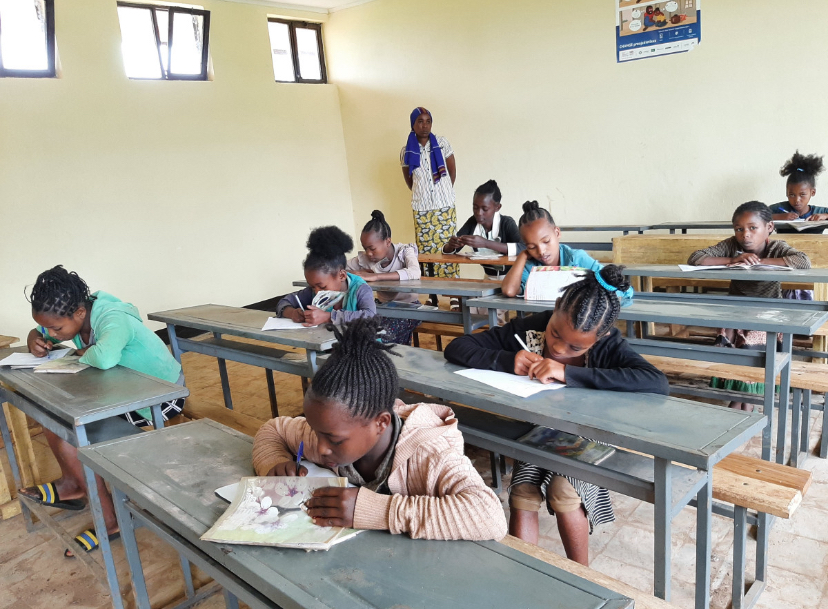
For millions of girls across Africa, getting into school is only part of the challenge.
Hunger, inadequate sanitation, poor menstrual hygiene support and unsafe learning environments continue to keep many out of the classroom or limit their ability to learn once they are there.
Increasingly, education experts argue that improving girls’ outcomes requires addressing these barriers together rather than through separate programmes.
That integrated approach was the focus of the 10th High-Level Dialogue on Girls’ and Women’s Education organised by the African Union International Centre for Girls’ and Women’s Education in Africa (AU/CIEFFA).
Under the theme “Integrating Nutrition and WASH to Advance Girls’ and Women’s Education in Africa,” policymakers, education experts and development partners explored how combining nutrition, water, sanitation and hygiene (WASH) and school safety with education could improve attendance, retention and learning outcomes for girls across the continent.
While the discussions centred on policy, practical examples from Ethiopia are already showing how this approach can work in practice.
One such example comes from Ethiopia’s Lasta District in the Amhara Regional State, where schools facing severe WASH challenges became part of an integrated programme led by Plan International Ethiopia.
Rather than simply constructing toilets, the initiative introduced dedicated menstrual hygiene management rooms where girls could change sanitary products privately, access clean water and receive menstrual health education.
At the same time, school feeding programmes in other parts of Ethiopia ensured children received regular nutritious meals, addressing another major barrier to learning in food-insecure communities.
Evaluations of these interventions reported measurable improvements. In schools with menstrual hygiene facilities and support programmes, girls’ attendance during menstruation reached 68 per cent compared with 30 per cent in schools without the intervention.
Confidence in accessing and using menstrual hygiene products also increased significantly. School feeding programmes produced similar gains, with children receiving daily meals missing fewer school days than those in schools without feeding programmes, reducing absenteeism and helping keep children engaged in learning.
The programmes succeeded because they addressed multiple challenges simultaneously. Local education authorities worked alongside water agencies, agricultural departments and community groups to deliver services through schools.
Farmers supplied food for school meals, water authorities supported sanitation facilities, while teachers and community volunteers promoted hygiene education and helped maintain the infrastructure. Rather than operating as isolated projects, the interventions became part of a broader effort to create healthier and more supportive learning environments.
However, the evidence also highlights important limitations. Although attendance improved, researchers found no significant difference in final academic performance between participating schools and comparison schools.
The findings suggest that improving attendance alone does not automatically translate into better learning. Quality teaching, adequate learning materials and effective classroom instruction remain essential if children are to achieve stronger educational outcomes.
The programmes also faced challenges beyond the classroom.
The COVID-19 pandemic and regional insecurity disrupted implementation in several communities, demonstrating how conflict and public health emergencies can undermine even well-designed interventions.
Long-term sustainability also remains uncertain where programmes rely heavily on donor funding rather than government budgets.
These lessons reinforce one of the key messages emerging from the AU/CIEFFA dialogue: improving girls’ education requires looking beyond school enrolment. A girl who is hungry, lacks access to safe sanitation or feels unsafe at school is less likely to attend consistently or perform well academically.
Addressing these interconnected barriers through coordinated investments in nutrition, WASH and school safety offers a practical pathway towards improving educational outcomes.
For African governments seeking to strengthen girls’ education, the challenge is no longer simply building more classrooms.
It is ensuring that schools provide the conditions children need to learn with dignity.
The experience from Ethiopia suggests that integrating nutrition, WASH and school safety into education is not a cure-all, but it is a promising, evidence-based approach that other countries can adapt while continuing to invest in teachers, learning resources and resilient education systems.